I’m sort of, okay not really “sort of”… I’m definitely frustrated right now because I was informed recently that a woman on Facebook was using photos that belonged to me, that are my property, photos of my cupcakes, and passing them off as hers. I wasn’t the only one- she was using someone elses too, and that woman found out sooner & reported her to Facebook. The photos have since been removed. This entire thing frustrates and angers me because what right does someone have to steal anything of mine and claim it as theirs? That goes for both intellectual property and tangible property. My photos, like my artwork, are mine. 100% copyrighted. Most of the recipes I post are not mine, and I give credit where it’s due. Otherwise, I expect that people will use the recipes, that’s what they’re here for. But the photos? Those are mine. Any photos of food I create are mine, meaning if you take them, I can sue you. I won’t, because I don’t have time for that shit. But I could. So anyone out there who either has stolen my pictures or was planning on it, do me a favor- get a life, get a camera and get your own photos. Thanks.
Now back to the food! Pickles are a weird thing, aren’t they? When you think about it, they’re such an old-timey food product. A vegetable soaked in salt and vinegar until it tastes nothing like what it originally did. Pickling was first used (and still is in some societies) years ago to preserve food without the help of refrigerators or ice boxes. Anything can be pickled, for example the famous Penn Dutch/Amish snack, “Chow Chow” (which I find GROSS). But thankfully nowadays more than anything the only pickled item we see or eat often are… well, pickles.
A pickled cucumber (commonly known as a pickle in Australia, Canada, and the United States) is a cucumber that has been pickled in a brine, vinegar, or other solution and left to ferment for a period of time, usually by either immersing the cucumbers in an acidic solution or through souring by lacto-fermentation.
Types
Gherkin
Main article: GherkinA gherkin is not only a pickle of a certain size but also a particular species of cucumber: the West Indian or Burr Gherkin (Cucumis anguria), which produces a somewhat smaller fruit than the garden cucumber (Cucumis sativus).[1] Standard pickles are made from the Burr Gherkin, but the term gherkin has become loosely used as any small cucumber pickled in a vinegar brine, regardless of the variety of cucumber used.
Kosher dill
A “kosher” dill is not necessarily kosher in the sense that it has been prepared under rabbinical supervision. Rather, it is a pickle made in the traditional manner of Jewish New York City pickle makers, with generous addition of garlic to the brine.[2][3]
At least one New York restaurant was serving dill pickles in the nineteenth century.[4]
Polish
Polish style pickled cucumbers (Polish: ogórek kiszony, plural: ogórki kiszone) are a type of pickled cucumber developed in the northern parts of Europe and have been exported worldwide and are found in the cuisines of many countries. As opposed to some other varieties of pickled cucumbers, they are prepared using the traditional process of natural fermentation in a brine which makes them grow sour. The brine concentration can vary between 20g/litre to more than 40g/litre of salt. There is no vinegar used in the brine of a Polish-style pickled cucumber.
The fermentation process is entirely dependent on the naturally-occurring Lactobacillus bacteria that normally cover the skin of a growing cucumber. Since these are routinely removed during commercial harvesting/packing processes, traditionally-prepared pickles can only be made from freshly-harvested cucumbers, unless the bacteria is artificially replaced.
Typically, small cucumbers are placed in a glass or ceramic vessel or a wooden barrel, together with a variety of spices. Among those traditionally used in many recipes are garlic, horseradish, whole dill stems with umbels and green seeds, white mustard seeds, oak, cherry, blackcurrant and bay laurel leaves, dried allspice fruits, and — most importantly — salt. The container is then filled with cooled, boiled water and kept under a non-airtight cover (often cloth tied on with string or a rubber band) for several weeks, depending on taste and external temperature. Traditionally stones, also sterilized by boiling, are placed on top of the cucumbers to keep them under the water. The more salt is added the more sour the cucumbers become. Since they are produced without vinegar, a film of bacteria forms on the top, but this does not indicate they have spoiled,and the film is simply removed. They do not, however, keep as long as cucumbers pickled with vinegar.
The concoction produced during the fermentation process, containing vitamins and minerals, is often consumed as a drink; it is also considered to be a remedy against hangover.
In Russia and Poland they are traditionally served as a side dish to vodka. In the United States and Canada, especially in Jewish communities and delis, they are sold alongside kosher dills in “full sour” and “half sour” varieties.
Hungarian
In Hungary, while regular vinegar-pickled cucumbers (Hungarian: savanyú uborkak) are made during most of the year, during the summer kovászos uborkak[5] (“leavened pickles”) are made without the use of vinegar. Cucumbers are placed in a glass vessel along with spices (usually dill and garlic), water and salt. Additionally, a slice or two of bread are placed at the top and bottom of the solution, and the container is left to sit in the sun for a few days so the yeast in the bread can help cause a fermentation process.
Lime
Lime pickles are soaked in lime rather than in a salt brine.[6] This is done more to enhance texture (by making them crisper) than as a preservative. The lime is then rinsed off the pickles. Vinegar and sugar are often added after the 24-hour soak in lime, along with pickling spices.
Bread and butter
Bread-and-butter pickles are sweeter in flavor than dill pickles, having a high concentration of sugar or other sweetener added to the brine. Rather than being served alongside a sandwich,[citation needed] they are more often used in fully-flavored sandwiches,[citation needed] such as hamburgers, or used in potato salad. Cucumbers to be made into bread and butters are often sliced before pickling.
Swedish and Danish
Swedish pickled cucumbers (pressgurka) are thinly sliced, mixed with salt and pressed to drain some water from the cucumber slices. Afterwards placed in a jar with a sour-sweet brine of vinegar, sugar, dill and mustard seeds.
Danish cucumber salad (agurkesalat) is similar, but the cucumbers are not pressed and the brine doesn’t have parsley. The cucumber salad accompanies meat dishes, especially a roasted chicken dish (gammeldags kylling med agurkesalat), and is used on Danish hot dogs.
Kool-Aid Pickles (a.k.a. “Koolickles”)
Kool-Aid pickles (enjoyed by children in parts of the Southern United States[7]) are created by soaking dill pickles in a mixture of Kool-Aid and pickle brine.
Well that was a long introduction to the world of pickles, wasn’t it?
I’m not a big pickle person. When I was a kid, I’d get those huge dill ones out of the barrels and nibble on it for an hour while my parents walked around the “Shopper’s Village” flea market. But I don’t know what happened- one day I just turned on my beloved pickles and ever since then I’ve been adamantly against them. I like the smell, and when I ate fast food I’d never say hold the pickles because I liked the flavor they gave the burger, but I won’t eat them. I always pass my pickle to Jay or whoever is eating with me (most people, I find, really like pickles). I do however like fried pickles, but only in moderation. After three or four of them I’ve had my fill.
But I found myself in the possession of many cucumbers, saw some jars for sale, and I decided to try my hand at making my own pickles. I figured, we always have at least one jar in the fridge and they go pretty quickly, plus I wanted to use up the cukes before they went soft. It just seemed like a fun thing to try. And then, whattaya know, the new Real Simple came and I saw there was a recipe for quick refrigerator pickles. It was a sign!
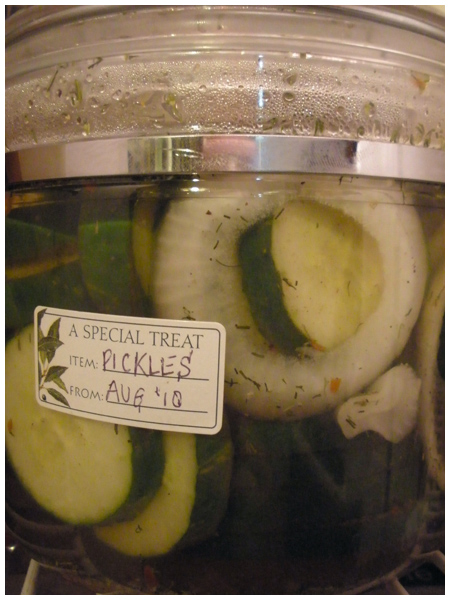
- ……………………………………………After only about an hour in the fridge…
…
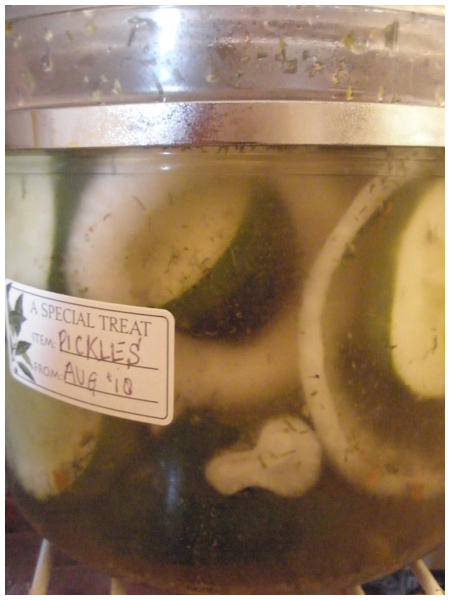
- …………………………………..And after about 16 hours in the fridge…
….
I made one jar as a test, and when I saw how well it turned out, I decided to try it again, this time cut lengthwise. I also think I might make these for others, which is a great idea… but if you do it, since they only keep a week in the fridge, make sure the person eats enough pickles not to waste them, and also that they know there’s a one-week time limit on them.
Mine were eaten alone, on the side of a homemade hamburger/corn on the cob meal and with sandwiches.
24 HOUR QUICK PICKLES
Ingredients:
- 4 Kirby cucumbers, cut either lengthwise or sliced
- ¾ cup white wine vinegar
- ¼ small sweet onion (such as Vidalia or Walla Walla), thinly sliced
- 2 cloves garlic, smashed
- 2 tablespoons sugar
- 1 teaspoon dill seed
- 1 teaspoon black peppercorns
- 1 teaspoon hot red pepper flakes*
- 1 bay leaf
- Kosher salt
Directions:
- Place the cucumbers in a 1-quart container with a tight fitting lid.
- In a bowl, combine the vinegar, onion, garlic, dill, peppercorns, pepper flakes, bay leaf, 2 teaspoons salt and ¾ cup hot tap water. Stir until the sugar dissolves.
- Pour the vinegar mixture into the jar with the cucumbers, cover tightly with lid, and refrigerate for at least 24 hours before serving. The pickles will keep up to 1 week.
The general consensus was that they were delicious. I used a bit more garlic in mine (in the form of an extra dose of garlic powder). I also added a little bit more salt, so they turned out more sour. I used regular cucumbers, not Kirby’s, and I also used regular dried dill, not dill seed. I left out the bay leaf too. All in all, it was a fun little experiment. I might want to try making real pickles, complete with the sealed Ball jars, since this went pretty well. These came out crisp with an incredible flavor, especially since they only “cured” for 24 hours. Everyone who tasted it could taste the red pepper flakes, which is good if you like things on the hotter side. Just keep that in mind when making yours.



 I'm Marilla. A 30-something artist, hobby baker, home canning enthusiast, gardener, DIY-er, wife, mommy of a baby boy and dog mom (to another baby boy) from New York.









Thieves suck. Pickles don’t. You definitely don’t. The End. 🙂
Haha thanks Elizabeth 🙂
Pickles are my best friend! I could compile a list for you of what to do to a thief with a pickle =o)
instead of suing said such butt head <3
LOL Lyns! I <3 you. I wouldn't sue over this, it isn't worth it. I just want these idiots to realize I am perfectly within my rights to do so, and it's serious business.
That thief certainly got herself in a “pickle” using lovely things that didn’t belong to her without permission. Sorry, had to go there. Glad you caught her, took your things back, and let her know what’s what.
LOL Amanda! Yeah she really did get herself in a “pickle.” Plus now everyone knows she was a fake, which is kind of a bonus 🙂
Attractive section of content. I simply stumbled upon your site and in accession capital to
say that I acquire actually enjoyed account your blog posts.
Any way I’ll be subscribing in your augment and even I fulfillment you
get admission to consistently quickly.
certainly like your web-site however you have to check the spelling on several of your posts.
A number of them are rife with spelling problems and I
to find it very troublesome to tell the reality on the other hand I will definitely come again again.
As soon as I noticed this internet site I went on reddit to share some of the love with
them.
you’re in reality a just right webmaster. The site loading velocity is incredible.
It seems that you’re doing any distinctive trick.
In addition, The contents are masterwork. you’ve done a fantastic activity on this matter!
I do not know if it’s just me or if perhaps everybody else
experiencing problems with your blog. It appears like some of the text in your content are running off the screen. Can someone
else please provide feedback and let me know if this is happening to
them as well? This could be a problem with my web browser because I’ve had this happen before.
Cheers
Have you ever thought about publishing an e-book or guest authoring on other sites?
I have a blog based on the same topics you discuss and would love to have you share some stories/information. I know my readers would appreciate your work.
If you are even remotely interested, feel
free to shoot me an e-mail.
I’m not that much of a online reader to be honest but your sites really nice, keep it up!
I’ll go ahead and bookmark your site to come back down the road.
Cheers
Hello there, I found your blog via Google whilst looking for a comparable matter,
your site came up, it looks good. I’ve bookmarked it in my google bookmarks.[X-N-E-W-L-I-N-S-P-I-N-X]Hello there, simply was aware of your weblog through Google,
and found that it’s truly informative. I’m gonna
be careful for brussels. I will appreciate if you proceed this in future.
Lots of other people will probably be benefited out of your writing.
Cheers!
I’d been honored to receive a call coming from a friend when he identified the important ideas shared on your own site.
Looking at your blog post is a real great experience.
Thank you for thinking of readers much like me, and I desire for you the
best of success as being a professional in this field.
I truly love your blog.. Great colors & theme. Did
you develop this web site yourself? Please reply back as I’m attempting to create my
own personal website and want to find out where you got this
from or exactly what the theme is named. Thanks!
I have been exploring for a little bit for any high-quality articles or blog posts in this sort of
area . Exploring in Yahoo I eventually stumbled upon this site.
Reading this info So i’m satisfied to express that I have a very just right uncanny
feeling I came upon exactly what I needed. I most for sure will make sure to don’t
disregard this site and provides it a glance regularly.
I have been examinating out many of your posts and it’s clever stuff.
I will definitely bookmark your website.
I enjoy you because of your entire work on this blog.
My niece enjoys making time for investigations and it’s obvious why.
Many of us learn all regarding the lively method you render both interesting and useful tricks through your web blog and therefore welcome response from people on that concern and
our own girl is being taught a great deal. Take pleasure in the remaining
portion of the new year. You have been conducting a terrific job.[X-N-E-W-L-I-N-S-P-I-N-X]I am extremely inspired with your writing talents and also
with the structure to your blog. Is this a paid topic or did you
customize it yourself? Either way stay up the nice quality writing, it’s uncommon to
see a nice weblog like this one nowadays.
What’s up, I read your blogs on a regular basis.
Your writing style is witty, keep it up!
I pay a quick visit everyday some websites and
websites to read content, except this website offers feature based content.
This is getting a bit more subjective, but I much prefer the Zune Marketplace. The interface is colorful, has more flair, and some cool features like ‘Mixview’ that let you quickly see related albums, songs, or other users related to what you’re listening to. Clicking on one of those will center on that item, and another set of “neighbors” will come into view, allowing you to navigate around exploring by similar artists, songs, or users. Speaking of users, the Zune “Social” is also great fun, letting you find others with shared tastes and becoming friends with them. You then can listen to a playlist created based on an amalgamation of what all your friends are listening to, which is also enjoyable. Those concerned with privacy will be relieved to know you can prevent the public from seeing your personal listening habits if you so choose.
The new Zune browser is surprisingly good, but not as good as the iPod’s. It works well, but isn’t as fast as Safari, and has a clunkier interface. If you occasionally plan on using the web browser that’s not an issue, but if you’re planning to browse the web alot from your PMP then the iPod’s larger screen and better browser may be important.
Everything is very open with a precise clarification of the issues.
It was really informative. Your website is extremely helpful.
Many thanks for sharing!
I am continually looking online for articles that can help me.
Thank you!
Hi, I do believe this is a great website. I stumbledupon it 😉 I am going to revisit yet
again since i have book-marked it. Money and freedom
is the greatest way to change, may you be
rich and continue to help other people.
Howdy! This is my first visit to your blog! We are
a team of volunteers and starting a new initiative in a community in the same
niche. Your blog provided us valuable information to work on. You have done a extraordinary job!
Very energetic article, I enjoyed that bit. Will there be a part 2?
I don’t know if it’s just me or if perhaps everybody else experiencing issues with your
blog. It seems like some of the text within your posts are running off the screen. Can someone else please
comment and let me know if this is happening to
them too? This may be a issue with my browser
because I’ve had this happen before. Thanks